

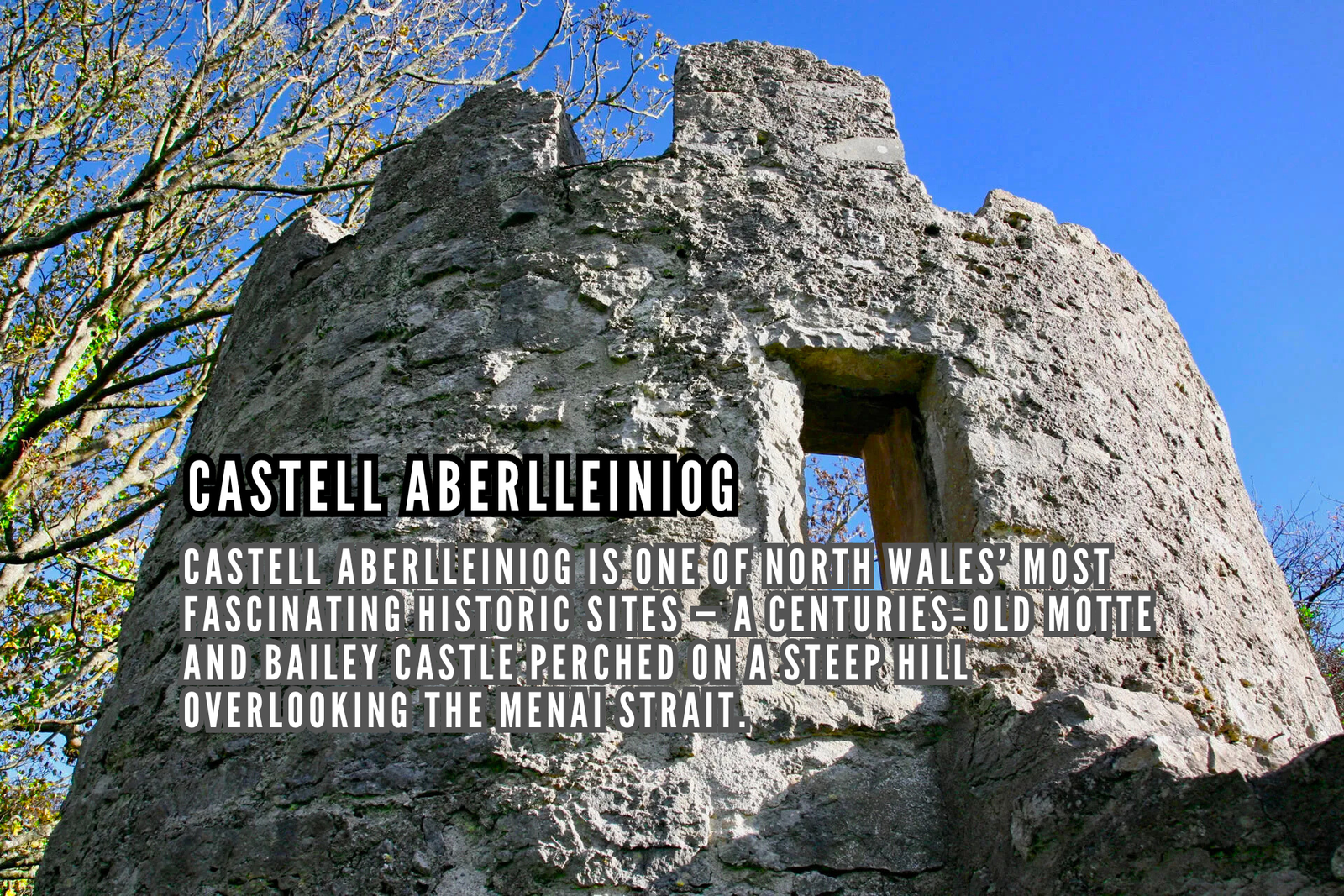
Castell Aberlleiniog is one of North Wales’ most fascinating historic sites — a centuries‑old motte and bailey castle perched on a steep hill overlooking the Menai Strait. Unlike more famous castles, Aberlleiniog remains quiet and hidden, wrapped in woodland and mystery. Few visitors know its name, yet its story is rich, dramatic, and filled with battles, sieges, restoration efforts, and centuries of silence. This castle is not just stones and earthworks; it is a symbol of Norman ambition, Welsh resilience, and history etched into the land.
An Ancient Fortress on the Edge of Conquest
Castell Aberlleiniog was built in the late 11th century, during a time when Norman invaders were consolidating power across Wales. Construction likely occurred between 1080 and 1099 AD, overseen by Hugh d’Avranches, 1st Earl of Chester, a powerful nobleman known as Hugh the Fat. Less than twenty years after the Norman conquest of England, the castle today is nearly a thousand years old.
Its design — a motte and bailey — was a hallmark of Norman military strategy. The motte is a raised mound topped with a defensive structure, originally made of wood, while the bailey is an enclosed courtyard below. These castles were built quickly but offered strategic advantage, enabling the Normans to dominate newly conquered territories.
A Powerful Strategic Location
The location of Aberlleiniog was no accident. Situated near the village of Llangoed on the Isle of Anglesey, the castle overlooks the Menai Strait, the narrow waterway separating Anglesey from mainland Wales. This stretch was a key transport and communication route in medieval times.
The castle stands atop a steep hill, which provided defensive strength and visibility. From the summit, defenders could survey miles of the strait and spot approaching forces. Signals could also be relayed to nearby Norman strongholds. Across the water, another Norman castle at Abergwyngregyn may have coordinated with Aberlleiniog, forming a strategic defense network
| Attribute | Details |
|---|---|
| Name | Castell Aberlleiniog |
| Type | Norman motte and bailey castle |
| Location | Llangoed, Isle of Anglesey, Wales |
| Built | Late 11th century (~1080–1099 AD) |
| Original Builder | Hugh d’Avranches, 1st Earl of Chester |
| Historic Events | 1094 siege by Gruffudd ap Cynan; later Civil War fortifications |
| Materials | Originally wood, later stone |
| Current Status | Ruins with walking paths; open to the public |
| Visitor Access | Free, year-round |
| View | Overlooks Menai Strait with woodland surroundings |
The Siege That Changed Its Fate
The castle’s history is closely linked to Gruffudd ap Cynan, a prince of Gwynedd. After years of captivity in England, Gruffudd returned to Wales and raised an army to reclaim his homeland. In 1094, his forces laid siege to Castell Aberlleiniog.
Historical accounts record that 124 Norman defenders were killed, and the castle was captured. This was not a minor skirmish; it marked a critical turning point in the struggle between the Welsh princes and Norman overlords for control of North Wales. Following the siege, Anglesey remained under Welsh control for about two centuries until the reign of King Edward I, who later constructed massive stone fortresses across Wales, including Beaumaris Castle.
From Earth and Wood to Stone
Originally, Castell Aberlleiniog was primarily built from wood and earth, like many early Norman fortifications. Wooden palisades and timber keeps were used because they could be erected quickly and effectively, and they sent a clear message of power.
Over time, the wooden structure was replaced with stone, though the exact timeline is unclear. By the mid‑17th century, a stone structure stood on the hilltop, with walls and round tower remnants that remain today. This stone fortification was likely adapted for military use during the English Civil War (1642–1651). Thomas Cheadle, the Constable of Beaumaris, oversaw fortification efforts, adding another layer to the castle’s story.
The Ruins That Tell Stories
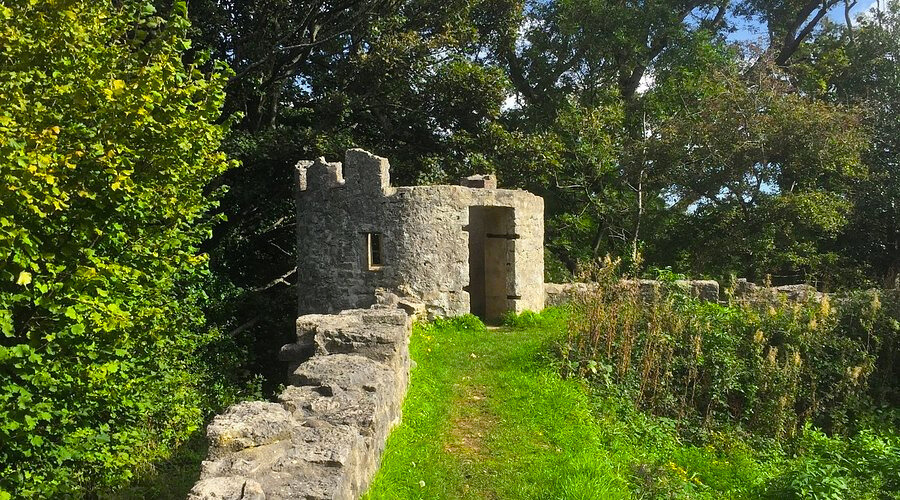
Today, Castell Aberlleiniog stands as a mix of earthworks, stone pillars, and ruined walls. The motte is still clearly visible, surrounded by a wide ditch that was part of its original defenses. Atop the mound lies a square stone platform, once enclosed by walls with round towers, though not all towers remain intact.
Walking paths wind up to the top, offering sweeping views of the Menai Strait, woodland, and distant Snowdonia mountains. The landscape reveals why this location was highly valued by the Normans and later occupiers. Even in ruin, the castle continues to tell stories of medieval life, battles, and adaptation over centuries.
Hidden in Nature and Rediscovered
For much of its later history, Castell Aberlleiniog was forgotten, overtaken by woods and overgrowth. Its remote location spared it from mass tourism and modern construction, yet left it hidden from casual visitors.
In the early 2000s, local heritage groups and volunteers began restoration efforts, stabilizing ruins, clearing paths, and making the site safe and accessible. Today, the castle is part of a conservation effort, surrounded by ancient woodland and scenic riverside paths. It is also included in the Anglesey Area of Outstanding Natural Beauty, highlighting its cultural and natural significance.
How to Visit Today
Visiting Castell Aberlleiniog is free and open year‑round. There is parking near Lleiniog, close to the Menai Strait. From here, a scenic woodland walk gradually leads visitors to the castle ruins.
The paths are enjoyable, taking you through ancient woodland, springtime bluebells, and open clearings. Interpretive signs provide insights into the castle’s layout and history. The site is family-friendly, though some uphill sections require moderate fitness. At the top, visitors are rewarded with panoramic views, making the climb worthwhile.
Why Castell Aberlleiniog Matters
While it may not be as famous as Beaumaris or Caernarfon Castle, Castell Aberlleiniog holds a unique place in Welsh history. It represents the earliest Norman attempts to control Anglesey and Gwynedd. It witnessed Welsh resistance, particularly during the 1094 siege, and played a role in later Civil War conflicts.
Its ruins and surrounding landscape also anchor the site in local legend and memory, reminding us that history is not only about grand castles but also about smaller, hidden places that shaped communities and culture.
A Place of Quiet Wonder
Unlike castles frequented by tourists, Castell Aberlleiniog offers quiet reflection. Walking among the ruins, one can imagine the shouts of battle, the clatter of Norman cavalry, and the lives of medieval defenders. Yet today, bird song replaces battle cries, and trees grow where palisades once stood.
This blend of history, nature, and heritage gives Aberlleiniog its special charm. It is a portal to the past, yet firmly rooted in the natural landscape of modern Wales. For those seeking both history and serenity, Castell Aberlleiniog is a must-visit hidden gem.
Final Thought
Castell Aberlleiniog may not boast towering walls like Beaumaris or Caernarfon, but its charm lies in its quiet resilience, hidden history, and connection to the land. Standing atop its ancient motte, surrounded by woodland and overlooking the Menai Strait, visitors can feel the weight of nearly a thousand years of history. It is a place where Norman ambition met Welsh courage, where battles were fought, and yet nature has reclaimed much of its quiet beauty.
For those willing to venture off the beaten path, Castell Aberlleiniog offers not just ruins, but a journey into the past, a chance to imagine medieval life, and a moment to appreciate the enduring power of history. It reminds us that some stories are not told through grandeur alone, but through quiet endurance, hidden beauty, and the whispers of time.
FAQs
Q: Where is Castell Aberlleiniog located?
A: It is on the Isle of Anglesey, near Llangoed, overlooking the Menai Strait in North Wales.
Q: How old is Castell Aberlleiniog?
A: The castle was built in the late 11th century, making it nearly 1,000 years old.
Q: Can visitors explore the castle ruins?
A: Yes, the castle is open year-round and walking paths lead to the ruins.
Q: What type of castle is Castell Aberlleiniog?
A: It is a Norman motte and bailey castle, originally built from wood and later rebuilt in stone.
Q: Is there a fee to visit Castell Aberlleiniog?
A: No, public access to the castle and surrounding paths is free.
