
When people mention a “Proud Emotion Face”, they usually aren’t talking about a real person. Instead, it’s a term to describe a facial expression or emoji that conveys pride — a powerful human emotion connected to achievement, confidence, and social status. In today’s digital world, emojis and facial expressions have become a universal language, and the proud emotion face is one of the expressions widely recognized across social media, messaging apps, and everyday interactions.
This article is a deep, researched guide on what the proud emotion face means, how it functions in psychology and communication, and how it appears in both real life and online culture. We’ll also clarify the misconception that it represents a person rather than an emotional signal we all share.
What Is a Proud Emotion Face?
A proud emotion face is not a celebrity, influencer, or public figure. It is a term used to describe a facial expression or symbol that shows someone feeling proud. In real life, this involves facial cues like a slight smile, lifted chin, and confident posture. People may show it consciously or subconsciously after achieving something meaningful.
In digital communication, emojis serve as shorthand for pride when words alone aren’t enough. Combining psychology, nonverbal communication, and digital culture, the proud emotion face helps us understand how emotion is conveyed across different platforms — from face-to-face interactions to online messaging.
The Psychology of Pride
Pride is a positive, self-conscious emotion that arises when someone feels they have accomplished something meaningful or socially valued. Unlike happiness, pride involves self-evaluation and reflection on personal achievements.
Research from the University of California, Davis shows that pride has distinct facial and body expressions, including a small smile, lifted head, and expanded posture, like standing taller or placing hands on hips. These cues signal confidence to others and can influence social perception and status.
The proud emotion face is thus more than decorative — it’s rooted in human behavior and evolved communication patterns, helping us convey achievement and self-assurance nonverbally.
Facial Expression and Body Language of Pride
The nonverbal expression of pride includes both facial and body cues. A subtle smile can indicate satisfaction or accomplishment, while a slightly tilted-back head signals confidence. Expanded posture, such as a raised chest or hands-on-hips, can make someone appear larger and more dominant.
These expressions have evolutionary roots and allow humans to communicate internal states to observers. Research confirms that pride is one of the few emotions that can be reliably recognized through posture and facial cues alone. Experiments show that people can identify pride just from the unique combination of facial and body signals.
| Attribute | Details |
|---|---|
| Name | Proud Emotion Face |
| Type | Facial expression / Emoji |
| Meaning | Shows pride, confidence, or achievement |
| Age | Not applicable |
| Height | Not applicable |
| Family | Not applicable |
| Net Worth | Not applicable |
| Lifestyle | Digital/real-life emotional expression |
| Physical Appearance | Slight smile, lifted chin, confident posture |
| Social Media | Represented via emojis, not a person |
Why We Use Facial Expressions Like Proud Emotion Face
Facial expressions, including pride, serve important social and communication functions. They help signal internal emotional states without words, influence perceptions of hierarchy and status, and foster trust and empathy in social interactions.
Pride expressions often attract positive social attention and can reinforce self-esteem. They also promote social bonding, as people feel pride not only for their own successes but also when witnessing achievements of those they care about.
Proud Emotion Face in Digital Culture
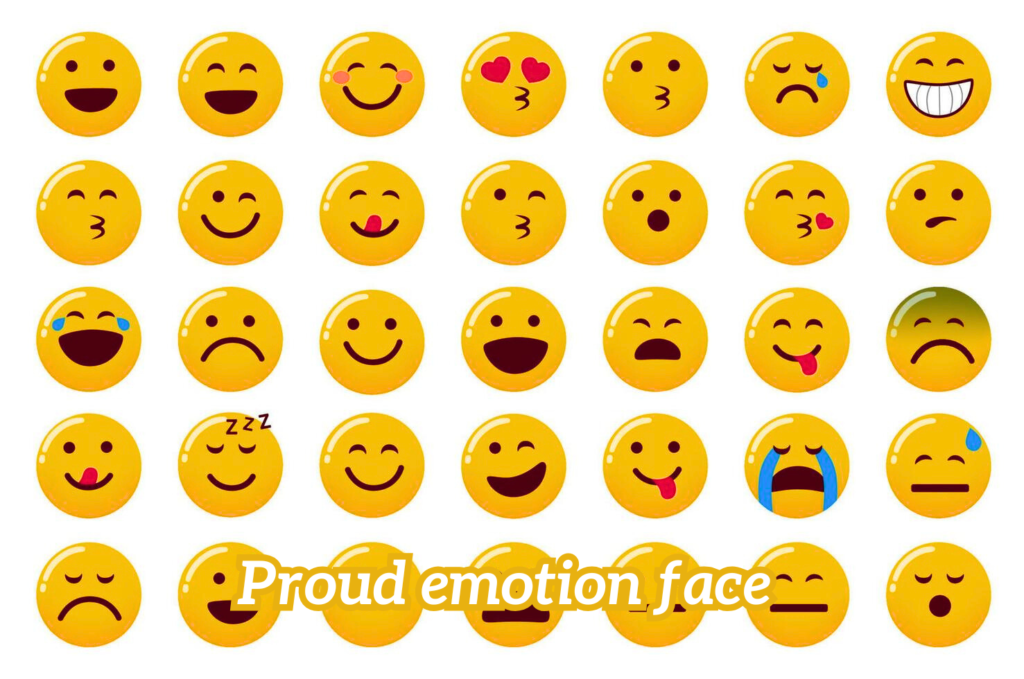
Online, the proud emotion face is often expressed using emojis. These visual symbols help convey confidence, achievement, or satisfaction in text-based communication. Common examples include:
😎 (Smiling Face with Sunglasses), 🤩 (Star-Struck), 🏆 (Trophy), 💯 (Hundred Points), 🥇 (1st Place Medal).
These emojis provide nuance to messages that plain text cannot deliver. Studies show that emojis can evoke emotional responses similar to real facial expressions, influencing mood and interpretation in digital communication.
The Science Behind Emoji and Human Expression
While emojis don’t replace real-life facial expressions, research demonstrates that people interpret emojis similarly to actual emotions. In some studies, participants even recognized basic emotions more accurately through emojis than through photographs of real faces.
In the context of pride, emojis can’t fully capture posture or subtle facial cues but effectively convey the emotional tone. Online cultures often combine emojis and text to enrich emotional communication and nuance.
Age, Identity, and Personal Traits Related to Expression
The proud emotion face does not belong to an individual, so there are no details like age, family, height, net worth, or biography attached to it. Instead, it’s a shared human expression visible across cultures, ages, and social groups. Teenagers, professionals, and content creators all use it to communicate accomplishment or confidence online.
Since it’s not a person, it has no physical traits or social media profile. It is purely a communication tool rooted in psychology and online behavior.
Understanding Pride in Everyday Life
People display the proud emotion face not only for personal success but also when feeling proud of others. Parents watching children achieve milestones, teammates celebrating victories, and mentors observing student growth all show expressions of pride.
Personality, culture, and context influence how pride is expressed, yet some aspects, like a small smile and upright posture, are universal. Research also shows that children recognize pride through facial and body cues, and this understanding grows as they develop.
Final Thought
The proud emotion face is a universal symbol of human achievement and confidence, bridging real-life interactions and digital communication. It reminds us that pride is not just a personal feeling but a social language that connects people, celebrates accomplishment, and inspires positivity.
Even without personal details like age, net worth, or social media presence, its importance lies in how it communicates emotion, reinforces self-esteem, and fosters social bonds. Recognizing and understanding the proud emotion face allows us to better appreciate human emotion, both in our daily lives and in the digital world where expressions travel faster than words.
FAQs
Q: What is a Proud Emotion Face?
A: It is a facial expression or emoji that shows pride, confidence, or achievement, not a real person.
Q: Can a Proud Emotion Face be recognized online?
A: Yes, through emojis or posts, people use it to show accomplishment or satisfaction.
Q: Does the Proud Emotion Face have personal details like age or height?
A: No, it’s a shared human expression and does not belong to any individual.
Q: How is pride expressed physically?
A: With a slight smile, lifted chin, and an open or expanded posture.
Q: Why do people use Proud Emotion Face in messages?
A: It communicates achievement, confidence, or positive emotion quickly and visually.
