

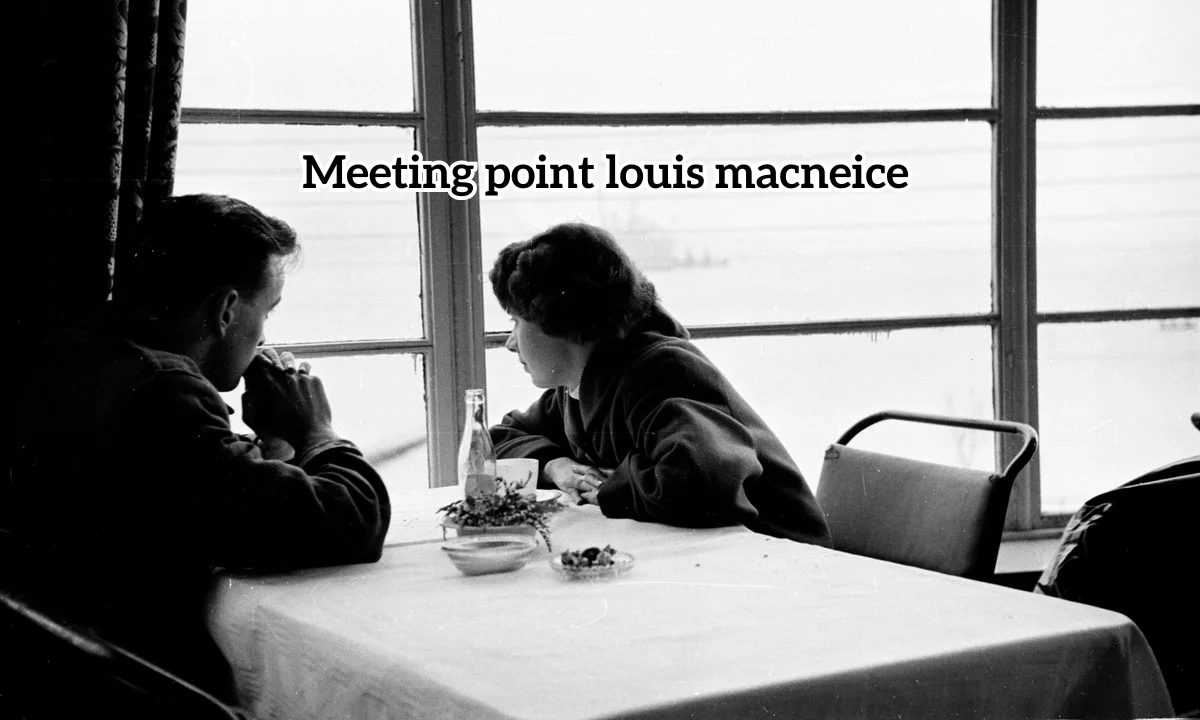
Meeting Point Louis MacNeice is one of the most enduring love poems of the 20th century. This short, lyrical piece captures something vast — how a momentary connection between two people can feel eternal. Written in 1939 by the Irish poet Louis MacNeice, the poem resonates across generations with readers who recognize in it a serene, almost prayer‑like sense of intimacy and presence. Behind these simple, evocative lines lies the story of a poet shaped by personal loss, artistic ambition, and emotional depth. In this article, we explore the meaning of Meeting Point Louis MacNeice, the life of the man behind it, and why the poem continues to feel deeply true, timeless, and universal.
Who Was Louis MacNeice? The Life Behind the Poem
Frederick Louis MacNeice was born on 12 September 1907, in Belfast, Ireland. He was the youngest child of Elizabeth Margaret (“Lily”) and Reverend John Frederick MacNeice, a Church of Ireland clergyman who later became a bishop. MacNeice’s mother came from Connemara and was a schoolmistress before marriage. Tragically, Lily suffered from health issues and passed away when Louis was a young boy, leaving a profound mark on him. This early experience of loss and longing would later surface in his poetry, including the delicate emotional layers in Meeting Point Louis MacNeice.
Though Irish by birth, MacNeice spent much of his life in England for education and career opportunities. He attended Sherborne and Marlborough schools and later studied classics at Merton College, Oxford. There he met peers like W.H. Auden and Stephen Spender, who became key figures in the literary circles of the time. Despite these influences, MacNeice’s poetry remained deeply personal, emotionally expressive, and uniquely his own, with Meeting Point Louis MacNeice being a prime example of his ability to capture intimate human moments.
Personal Life — Family, Love, and Influence
Louis MacNeice’s personal life was complex and rich, shaped by both love and loss. In 1930, he married Mary Ezra, though the marriage ended in 1936. Later, in the early years of World War II, he married Hedli Anderson, a singer and actress who became a profound emotional anchor in his life. They had two children, Daniel MacNeice and Brigid Corinna MacNeice, known affectionately as “Bimba.” This family life provided him with emotional grounding that subtly informed his work, giving poems like Meeting Point Louis MacNeice their warmth and resonance.
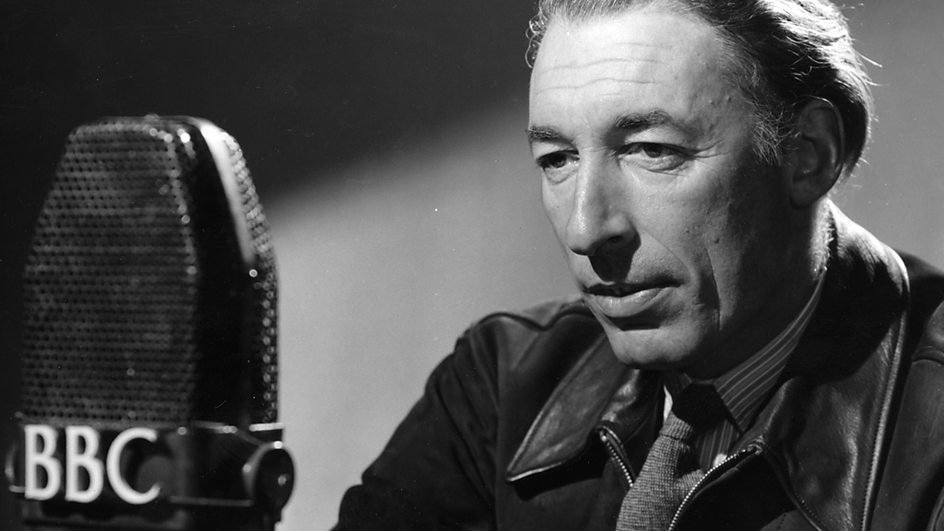
MacNeice faced periods of depression, the emotional residue of early loss, and challenges in balancing his artistic ambitions with professional responsibilities. His career took him from teaching at the University of Birmingham to lecturing in Greek at Bedford College in London and eventually to the BBC, where he wrote and produced radio plays and programs. His experiences in these diverse roles enriched his literary vision, allowing him to write poetry like Meeting Point Louis MacNeice that is emotionally immediate and intellectually grounded.
Because he lived before the era of social media or modern celebrity, there are no public records of his height, lifestyle, or net worth. What remains, however, is a lasting body of work — a legacy that continues to speak more powerfully than any social platform ever could.
| Field | Details |
|---|---|
| Full Name | Frederick Louis MacNeice |
| Born | 12 September 1907, Belfast, Ireland |
| Died | 3 September 1963, London, England |
| Occupation | Poet, Playwright, BBC Producer |
| Famous Work | Meeting Point (1939) |
| Parents | John Frederick MacNeice (father), Elizabeth Margaret MacNeice (mother) |
| Spouse(s) | Mary Ezra (1930–1936), Hedli Anderson (1942–1960) |
| Children | Daniel MacNeice, Brigid Corinna MacNeice |
| Education | Merton College, Oxford (Classics) |
| Themes | Love, Time, Memory, Intimacy |
| Net Worth | Not documented |
| Social Media | Not applicable (lived before social media) |
Meeting Point Louis MacNeice — A Poem in Focus
At the heart of MacNeice’s poetic legacy is Meeting Point Louis MacNeice, first published in 1939. Its most recognizable opening line — “Time was away and somewhere else” — appears repeatedly throughout the text, creating a refrain that frames the poem’s structure while echoing its emotional rhythm. This repetition anchors the poem in a sense of suspended time, reflecting the poem’s central theme: the ability of love to make moments feel eternal.
The poem opens with ordinary domestic images — two chairs, two glasses — yet from these humble beginnings, MacNeice constructs a world both intimate and transcendent. Ordinary objects gain symbolic significance, and the space of a café transforms into a landscape of the heart. Shared presence becomes expansive, demonstrating how Meeting Point Louis MacNeice elevates small moments into profound experiences.
The speaker’s perception transforms further into dreamlike imagery, as in the line “Camels crossed the miles of sand…”, blending the mundane with the remarkable. This shift underscores how love reshapes perception and renders time itself irrelevant, a theme central to Meeting Point Louis MacNeice.
Themes — Love, Time, and Memory
A defining feature of Meeting Point Louis MacNeice is its meditation on time — not measured in hours and minutes, but experienced psychologically and emotionally. The poem suggests that moments of intense connection can feel so complete and vivid that conventional time fades. This resonates universally: we have all experienced moments where time seems suspended, where love or closeness makes the world feel paused.
Memory plays a crucial role as well. In the poem’s final lines, “Time was away and she was here”, the focus subtly shifts from general timelessness to the enduring presence of a loved one. Even when the moment passes, memory lingers. Love becomes a lasting emotional echo, one that readers can relate to, reinforcing the timeless relevance of Meeting Point Louis MacNeice.
The poem balances immediacy with reflection. It doesn’t merely describe love — it evokes it, inviting readers to recognize similar quiet, meaningful moments in their own lives. In doing so, it becomes not just a poem but a shared human experience.
Style — Repetition, Rhythm, and Imagery
MacNeice’s style in Meeting Point Louis MacNeice enhances its emotional power. The repetition of phrases creates musicality, mimicking the rhythm of thought, breath, and feeling. This cyclical quality mirrors how intense experiences loop in the mind — arriving, returning, and settling into memory.
Imagery is deceptively simple yet rich. The silent bell, the desert sands, a familiar café — these elements are not merely decorative; they serve as portals into the psyche, allowing readers to inhabit the poem both visually and emotionally. MacNeice’s diction blends clarity with lyrical depth. There are no obscure metaphors, only ordinary language reshaped by the intensity of feeling, making Meeting Point Louis MacNeice both accessible and profoundly moving.
Legacy — Why It Still Resonates
Louis MacNeice may not be as widely studied as some of his contemporaries, but his poetry continues to resonate because it speaks to universal human experiences. His work feels lived in, authentic, and emotionally sincere. Meeting Point Louis MacNeice remains beloved because it distills a pure emotional moment: simple, profound, and universal. It reminds us that life’s most significant moments often occur quietly, in the spaces between routine events, captured beautifully in the poem’s structure and imagery.
Conclusion
Meeting Point Louis MacNeice is more than a love poem; it is a tribute to human connection and emotional presence. Within its lines, MacNeice creates a world where time pauses, perception shifts, and ordinary moments transform into extraordinary experiences. He reminds us that even small gestures — a glance, a shared silence, a simple conversation — can carry immense emotional weight.
Though Louis MacNeice lived long before the age of social media or celebrity culture, his insight, humanity, and literary artistry continue to endure. Each line of Meeting Point Louis MacNeice invites readers to feel, reflect, and remember: a timeless meeting point between life, love, and art.
FAQs
Q: What is “Meeting Point Louis MacNeice”?
A: It is a famous love poem written by Irish poet Louis MacNeice in 1939, exploring love, time, and intimacy.
Q: Who wrote “Meeting Point Louis MacNeice”?
A: The poem was written by Louis MacNeice, an Irish poet and BBC producer born in 1907.
Q: What is the main theme of “Meeting Point Louis MacNeice”?
A: The poem focuses on love, memory, and the suspension of time during intimate moments.
Q: When was “Meeting Point Louis MacNeice” published?
A: It was first published in 1939 and has been widely studied in literature.
Q: Is “Meeting Point Louis MacNeice” about real people?
A: No, it is a lyrical poem inspired by universal experiences of love, not a real-life biography.
